Why You’re Still Tired After 8 Hours of Sleep — And What Actually Helps
Sleeping 8 hours but still exhausted? Discover the real reasons behind poor sleep quality and evidence-based, natural ways to actually feel rested.
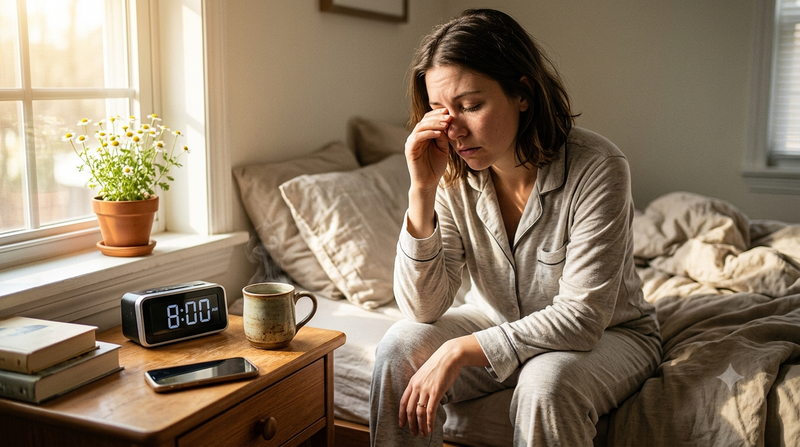

sleep quality vs sleep quantity, natural sleep remedies, improve sleep naturally, sleep hygiene tips
If you’re doing everything “right” and still waking up exhausted, the problem probably isn’t how long you slept. It’s how well.
You did everything right last night. Lights out at a reasonable hour, phone mostly put away, a full eight hours between your head hitting the pillow and your alarm going off. And yet you woke up feeling like you’d been run over.
(Writer’s note: swap this opening for a real moment of your own if you have one — readers connect fastest with a specific night they recognize.)
If that sounds familiar, you’re not imagining it, and you’re not alone. According to the CDC, roughly one in three American adults regularly don’t get the sleep they need — and a large part of that isn’t about hours logged, it’s about what happens during those hours.
Here’s the piece that gets left out of most “just get 8 hours” advice: sleep isn’t one long, uniform block of rest. It’s a cycle. And when that cycle gets quietly interrupted — in ways you never wake up enough to notice — you can spend a full eight hours in bed and still feel like you got two.
Let’s look at what’s actually happening, and what’s worth trying instead.
Sleep Is a Cycle, Not a Switch
Each night, your body moves through roughly four to six 90-minute sleep cycles. Within each cycle, you pass through light sleep, deep sleep, and REM (rapid eye movement) sleep, where most dreaming happens.
Deep sleep is when your body does most of its physical repair. REM sleep is heavily involved in memory processing and emotional regulation. You need a healthy dose of both — not just total hours — to wake up feeling human.
This is why sleep researchers and the CDC increasingly talk about sleep in terms of quality, not just quantity: uninterrupted, restorative sleep matters as much as clocking eight hours on paper. You can spend eight hours in bed and barely touch deep or REM sleep if something keeps nudging you back into lighter stages — often without ever waking you up enough to remember it.
That’s the trap. The disruption is invisible to you, but your body feels every bit of it.
The Hidden Reasons You’re Waking Up Exhausted
The “Nightcap” That Backfires
A drink before bed feels like it helps you fall asleep faster — and it often does. But that’s only half the story.
Research consistently shows that alcohol suppresses REM sleep in the first half of the night, then triggers a “rebound” of lighter, more fragmented sleep in the second half as your body metabolizes it. You fall asleep quickly, but you’re trading away the deep, restorative stages that actually make you feel rested.
Your Evening Screen Time Is Working Against You
Light — especially the blue wavelengths emitted by phones, laptops, and TVs — suppresses melatonin, the hormone your brain uses to signal that it’s time to wind down. In one well-known Harvard study, blue light suppressed melatonin production for roughly twice as long as comparable green light.
The result: even if you eventually fall asleep, your circadian rhythm (your internal 24-hour clock) is quietly out of sync, which can push you toward lighter, less restorative sleep.
An Inconsistent Schedule Confuses Your Body’s Clock
Going to bed at 10 p.m. on weekdays and 1 a.m. on weekends doesn’t just cost you sleep — it confuses the internal clock that decides when your body wants to enter deep sleep versus when it wants to be alert. Your circadian rhythm thrives on consistency, and irregular timing is one of the most underrated reasons people feel jet-lagged in their own bed.
A Racing Mind Keeps You in Lighter Sleep
Stress doesn’t just keep you awake at bedtime. An overactive nervous system can keep pulling you back toward lighter sleep stages throughout the night, even while you’re technically asleep the whole time.
It Could Be Something More
Sometimes, persistent exhaustion despite consistently good habits is a sign of an underlying sleep disorder — most commonly sleep apnea. What makes it tricky is that many of its clues show up during the day, not at night: morning headaches, brain fog, irritability despite “enough” sleep, or a partner noticing loud snoring with pauses or gasping. If that sounds familiar, it’s worth a conversation with a doctor rather than more troubleshooting on your own. This is one of the more common — and treatable — causes of “tired no matter what I do.”
What Actually Helps (Backed by Real Evidence)
The good news: most of the highest-impact fixes are free, and none of them require an overnight overhaul.
Get Morning Light, Consistently
Exposure to natural light shortly after waking — even 10 to 30 minutes — helps anchor your circadian rhythm, making it easier to fall into deep sleep at night. It’s one of the most consistently recommended habits from sleep researchers, and one of the easiest to start tomorrow morning.
Build a Real Wind-Down Routine
Give yourself a buffer, ideally 30 to 60 minutes, before bed where you’re off screens. Reading, light stretching, or simply dimming the lights signals to your brain that sleep is coming — instead of asking it to switch from bright screens to darkness in sixty seconds.
Rethink Your Evening Drinks
If you rely on alcohol to fall asleep, try shifting your last drink earlier in the evening, or skipping it a few nights a week to see how your energy responds the next day. The same goes for caffeine — it has a longer half-life than most people assume, so that 3 p.m. coffee may still be working against you at 10 p.m.
Try Actual Relaxation Techniques
This is one area where the evidence is genuinely solid: techniques like progressive muscle relaxation, deep breathing, and guided imagery have real research support for improving sleep. Unlike trendier fixes, these don’t require equipment or a subscription — just a few quiet minutes before bed.
Let Herbal Teas Be a Ritual, Not a Cure
Chamomile and similar herbal teas have been part of bedtime routines for generations, and there’s real value in a calming, screen-free ritual before bed. If you find peace in these natural remedies, there is something incredibly grounding about growing them yourself. Cultivating your own calming herbs with a Medicinal Seed Kit is a wonderful way to deepen your connection to your evening wind-down process right from your own garden or windowsill.
But it’s worth being honest about the evidence: reviews from the National Center for Complementary and Integrative Health haven’t found chamomile or valerian to be consistently effective for treating insomnia specifically, even though some smaller studies suggest modest benefits for certain groups. Treat a warm cup of homegrown tea as a pleasant cue that signals “wind-down time,” not a guaranteed fix — and if you’re on medication or pregnant, check with a doctor before adding any herbal supplement to your routine.
Know When to Loop In a Professional
If you’ve cleaned up your sleep habits and you’re still waking up exhausted, that’s useful information in itself. It suggests the issue may need a doctor’s help to investigate, rather than something you can out-habit on your own.
Quick Recap
Sleep quality — how much deep and REM sleep you get — matters as much as total hours.
Alcohol, screens, irregular schedules, and stress can quietly fragment sleep without ever fully waking you.
Morning light and a consistent wake-up time are usually the highest-leverage fixes to start with.
Relaxation techniques have solid evidence behind them; herbal teas are a nice ritual, not a proven cure.
Persistent exhaustion despite good habits is worth raising with a doctor, not just pushing through.
The Bottom Line
Feeling tired despite “enough” sleep isn’t a personal failing, and it’s rarely fixed by simply going to bed earlier. More often, it’s a sign that something — alcohol, screens, an irregular schedule, stress, or an undiagnosed sleep issue — is quietly interrupting the deeper stages of sleep your body actually needs.
Start with one change, not all five. Morning light and a consistent wake-up time are usually the best place to begin, since they help reset the internal clock everything else depends on. Give whatever you try at least two weeks before judging whether it’s working — these changes compound over time, not overnight.
Note: This article is for educational purposes and isn’t a substitute for medical advice. If sleep problems are persistent or affecting your daily life, talk to a healthcare provider.
Sources referenced:
Centers for Disease Control and Prevention (CDC) — Sleep and Sleep Hygiene
National Center for Complementary and Integrative Health (NCCIH) — Sleep Disorders and Complementary Health Approaches
Sleep Foundation — Alcohol and Sleep
Harvard Health Publishing — Blue Light Has a Dark Side
Mayo Clinic — Obstructive Sleep Apnea: Symptoms and Causes

Comments
No comments yet. Be the first to comment!